Building on a Strong Foundation
This project represents an expansion of TRAFFIC’s work in the Congo Basin, Asian, and EU markets. It builds upon more than a decade of investment into government and private sector engagement on the timber trade between the Congo Basin and China through previous projects. Our most recent initiative, “Leveraging Legality along China’s Timber Supply Chain to Reduce Deforestation,” kickstarted the development and introduction of our technology suite and expanded our engagement into Vietnam.
While our earlier work provided the baseline for governance, this new phase, supported by the UK’s Forest Governance, Markets and Climate (FGMC) Programme, scales these efforts to include traceability, cross-border financial oversight, international policy alignment, and a deepened commitment to social equity.
$152 Billion
The estimated annual value of forestry-related financial crime, which fuels international money laundering and corruption.
Powered by Tech for Trees
At the heart of this project is the Tech for Trees technology suite. This initiative provides the essential data, expertise, and digital tools needed to stop ecosystem destruction by ensuring timber trade is legal and traceable. By integrating these innovative solutions into routine state-led operations, we are helping governments and law enforcement pinpoint illegal activity and transform forest management.
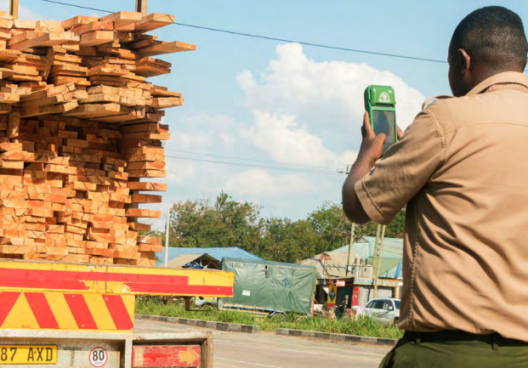
Timber Tracker
A revolutionary handheld electronic device used by forest law enforcement at checkpoints along transport routes. It allows for real-time digital verification of waybills through barcode scanning, ensuring timber shipments are validated against national legality records as they move through government checkpoints
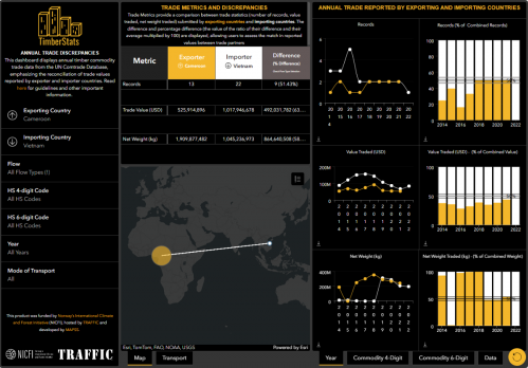
TimberStats
A trade discrepancy tool that analyzes national import versus export data. By highlighting inconsistencies, it enables officials to identify potential trafficking, fraud, and money laundering routes.

Xylorix Enforcer (Wood ID)
A smartphone-based species identification tool. Using AI-supported anatomical analysis, it enables rapid species verification at border points to detect fraud involving CITES-listed and other protected timber species.
The Challenge
Illegal timber trade from the Congo Basin continues to drive deforestation, deplete national revenues, and fuel complex financial crimes. Despite progress, high demand in markets like China, Vietnam, Malaysia, and Europe often creates powerful incentives for illegal harvesting when due diligence systems are bypassed.

Our Integrated Approach
To address these transnational drivers, we connect four vital areas of intervention:
Strengthening Source Governance: Supporting the implementation of updated national legality frameworks, such as Cameroon’s 2024 Forest Law, and improving enforcement through digital traceability.
Promoting Responsible Sourcing: Working with industry associations in China and Vietnam to adopt robust Codes of Conduct and due diligence checklists. This includes strengthening the capacity of China's public procurement auditors to verify the legality of timber sourced from the Congo Basin.
Targeting Financial Crime: Equipping Financial Intelligence Units (FIUs) across Africa, Asia, and Europe with analytics to treat illegal logging as a serious financial crime.
Global Policy Alignment: Communicating best practices for timber trade and advocating for the formal recognition of forestry crime in international financial regulatory frameworks through platforms like the ITTO and APEC.

Project Partners
- Government Agencies:
- Ministry of Forestry and Wildlife (MINFOF - Cameroon)
- Ministry of Forest Economy (MEF - Republic of the Congo).
- Vietnam Administration of Forestry (VNFOREST - Vietnam).
- Ministry of Natural Resources and Environmental Sustainability (NRES - Malaysia).
This project is supported by the UK Government’s Forest Governance, Markets and Climate (FGMC) Programme. The FGMC programme is the Foreign, Commonwealth and Development Office’s (FCDO) flagship global forest governance initiative. A global programme supporting governance and market reforms aimed at reducing the illegal use of forest resources, benefitting poor forest-dependent people, promoting sustainable growth and climate change mitigation in developing countries.