

Mount Cameroon, Cameroon. Photo: Andrew Walmsley/Traffic
i
Technology tools to stop illegal timber trade
From innovative tracking and wood identification tools, to instant import-versus-export-data analysis, technology is key to stamping out illegal timber trade.
More and more, governments, communities and businesses are seeking solutions focusing on legal and sustainable trade, because they understand how deeply human survival relies on forests.
TRAFFIC is working alongside them, providing technology, data and expertise to help stop ecosystem destruction by illegal timber trade.
Forests host 80% of terrestrial species and are vital to our survival. With forest crime worth $51-152 billion annually, traditional monitoring can't keep pace.
New approaches are essential to combat deforestation
Our technology tools
TIMBER TRACKER

WOOD ID

TIMBERSTATS


Our suite of technology tools has the potential to revolutionise how the timber trade is controlled, safeguarding life-sustaining forests. This enables fair trade of legal timber, assuring buyers of legality and benefiting the rightful suppliers.
Chen Hin Keong, TRAFFIC’s Senior Advisor on Forest Governance and Trade
TIMBER TRACKER
The challenge
As with many products derived from the wild, tracing the supply chain is the biggest challenge in detecting illegally sourced timber.
Within timber source countries, timber is checked and verified at a series of checkpoints from origin to export or destination within the country. But sheer volumes, inefficient processes, and conflicting interests make monitoring timber trade a huge challenge during these daily forestry operations.

The tech solution
The Timber Tracker is an innovative handheld electronic device similar to those used for supermarket inventory control. It digitises the time-consuming process of checking consignments and sends the information to a centrally managed database.
When using Timber Tracker, authorities gain full and immediate oversight of the movement of forest products and revenue collection from them, thereby reducing opportunities for corruption. Should something go amiss (for example, alteration of records), it can be traced back to exactly where it happened in the supply chain.

The benefits
The task of conducting checks on goods is made much simpler, faster, and consistent
It improves the reputation of forest management bodies
Using timber tracker can vastly increase government revenues from legal timber and forest produce trade, and shift profits away from black markets
By helping to ensure legal trade, the system protects the future of tropical forests

Timber Tracker In practice
Since the introduction of Timber Tracker in Tanzania in 2016, national revenue from timber has increased by around 50%, as illegal timber trade is stamped out, and local traders see the benefits of easy, transparent, and speedy processes.
TRAFFIC is now working to roll out similar systems in Cameroon and the Republic of the Congo, which are important transit countries for timber moving from the Congo Basin (the world's second-largest rainforest) through Vietnam and into China.

Timber Tracker use in Tanzania (credit: Sam Obae/ TRAFFIC)
i
WOOD ID
The challenge
A critical part in ensuring timber and timber products are legal is identifying the species in question, so that it can be checked against the accompanying documentation, and the regulations that allow or disallow its trade.
But identifying timber species on the ground has always been a bottleneck. Without the tools to distinguish protected woods from legal ones, enforcement officers are often forced to rely on paperwork or field guides; a process that can take hours, or worse, lead to missed detections.

The tech solution
The Wood ID application, adapted from the Xylorix enforcer developed by Agritix, enables enforcement officers to identify timber species in the field using AI technology.
Officers photograph wood samples with a smartphone and macroscopic lens, and the app compares them against a cloud-based database while providing access to relevant regulations.
This allows officers to verify timber legality in situ and in real time and process shipments more efficiently.

The benefits
Compact and compatible with any phone camera, making it highly portable and convenient.
Automated identification of wood species removes human error and vastly speeds up the process of checking timber consignments.
Allows instant data sharing between enforcement teams, boosting collaboration across borders and reducing unnecessary delays for legitimate timber shipments.

WOOD ID In practice
The tool has been tested on 43 high-risk species selected based on IUCN Red List status, CITES listings, and commercial prevalence. These include Siamese rosewood (Dalbergia cochinchinensis), Burmese rosewood (Dalbergia oliveri), and Tali (Erythrophleum ivorense).
TRAFFIC piloted the tool with 75 frontline officers in Vietnam and will continue expanding Wood ID's database—aiming for 50 species by 2026—while delivering more training across Vietnam, Cameroon, and the Republic of the Congo, where timber exports and enforcement needs are greatest.

WOOD ID training with law enforcement officers in Vietnam
i
TIMBERSTATS
The challenge
The global timber trade is worth up to USD 500 billion annually, with 15-30% estimated to be illegal. The sheer scale of this trade makes effective regulation nearly impossible with current resources, leading to unsustainable logging.
The core challenge is one of scale: maintaining full oversight of timber trade dynamics and managing such an enormous global market requires a vast amount of resources.

The tech solution
TimberStats helps fight illegal timber trade by making it easier for law enforcement, governments and banks to potentially spot suspicious shipments and investigate further. The platform uses UN Comtrade data - the most widely used and relied-upon source of official trade records worldwide.
Developed by TRAFFIC in collaboration with M.A.P Scientific Services, TimberStats allows users to compare what different countries report about their timber trade. When one country reports exporting a certain amount of timber, but the receiving country reports a different amount, value, or net weight, something suspicious may be happening.
Where discrepancies are particularly large, this can act as a red flag for potential activities such as false documentation, smuggling, money laundering and corruption.

The benefits
Users can search and filter the data by year, country, or company to get a general picture of timber trade: which countries are the top exporters and importers of timber, the occurrence of particular product types, the value of reported timber trade by year, and more.
Law enforcement can use this to focus on high-risk shipping routes and investigate the companies and vessels involved.
Banks can check whether their clients are exposed or contributing to questionable timber deals.

TIMBERSTATS In practice
TimberStats brings together trade information from 79 countries across South America, sub-Saharan Africa, and Southeast Asia, making it much faster and easier to do work that used to take weeks or months.
TimberStats is freely accessible via TRAFFIC's Wildlife Trade Portal and is currently available in English, Chinese, French, and Vietnamese.

TRAFFIC initiative to leverage legality along timber supply chains
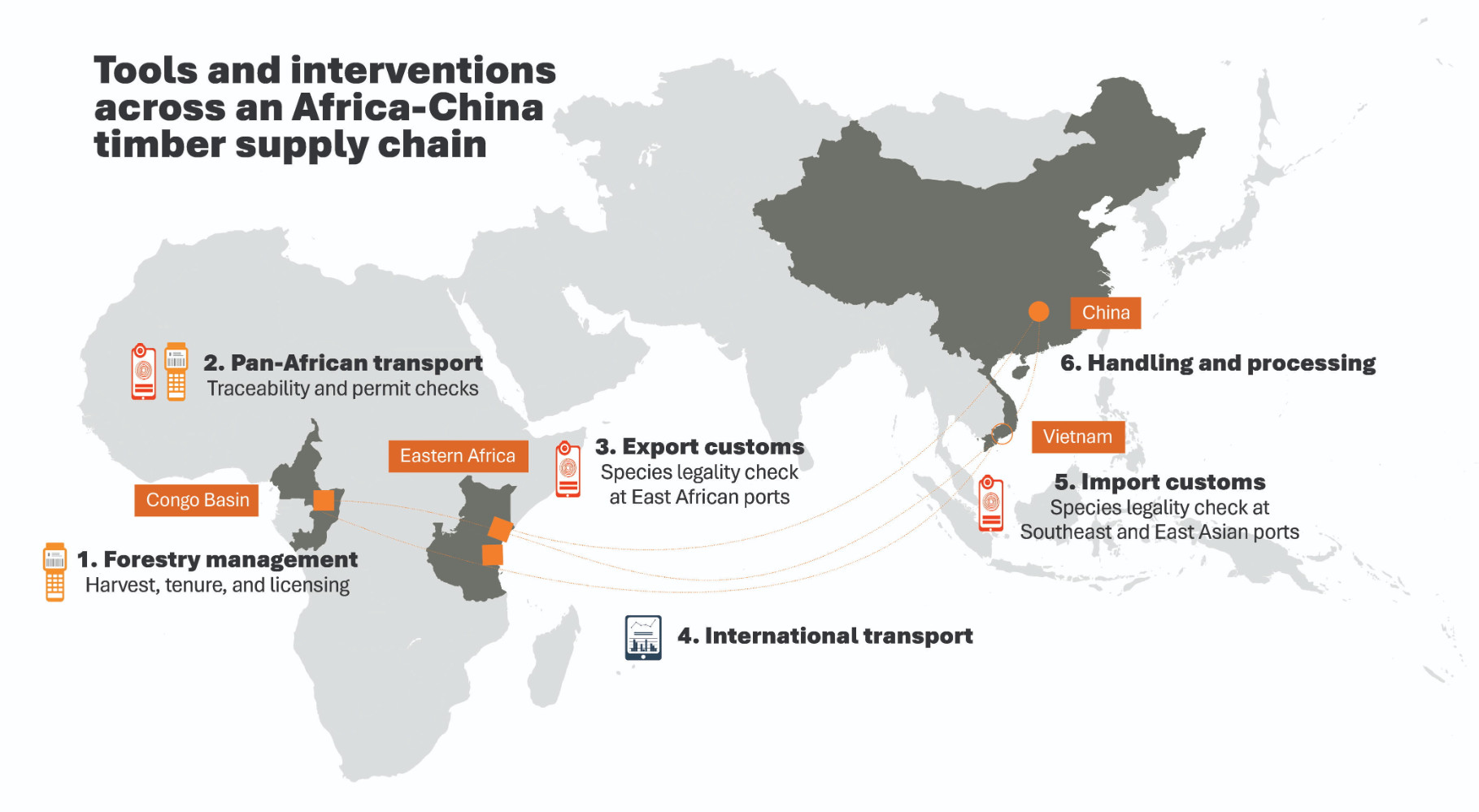
Over a five-year initiative, TRAFFIC worked along a key tropical timber supply chain—from the heart of the Congo Basin to the transit hubs in Viet Nam, before reaching the consumer markets of China—aiming to protect the ecosystem, combat deforestation, and promote sustainable development for local communities.
The map shows the tools and targeted interventions that were implemented across the entire supply chain, helping to verify the legitimate sourcing of timber products.
latest news related to timber trade
latest news and reports related to the project and our wider work on legal, sustainable timber trade

thank you
This initiative was implemented as part of the project "Leveraging legality of China's timber supply to reduce deforestation", funded by Norway's International Climate and Forest Initiative (NICFI).


TRAFFIC is a registered UK charity, Number 1076722. Company Number 3785518.
Our headquarters are located at TRAFFIC, David Attenborough Building, Pembroke Street, Cambridge, CB2 3QZ
TRAFFIC is a member of the


©2026 TRAFFIC INTERNATIONAL. All rights reserved.
Developed by Ian Kimber at Lakeside Web Services, designed by Marcus Cornthwaite.