
Before the cage: tackling African grey parrot trafficking from forests to buyers
In the forests of Central Africa, a unique and vital seed disperser is being lost to illegal trade, while a disturbing new threat is emerging.
African grey parrots continue to be targeted for illegal trade, with wild birds at risk of being trapped, moved through trafficking networks, and sold as pets.
To help reduce this pressure, TRAFFIC and partners are working at different points in the trade chain: reaching potential buyers in China before a purchase is made, while supporting community awareness and intelligence-gathering in source landscapes around Lobéké National Park in Cameroon.
In China, a targeted digital campaign, including the film below, reached consumers with practical information to help them avoid buying parrots without legal documentation. In Cameroon, community awareness activities raised understanding of the species’ protected status and legal risks of trafficking, while also highlighting the concerning emerging trade in African grey parrot blood, skulls and red tail feathers.
Together, the work shows how African grey parrots can be better protected when action happens across the trade chain: reducing demand among potential buyers, while supporting communities closest to the forests where wild birds are at risk.
In China, the campaign generated more than 20 million impressions, reaching around 1.6 million targeted users on Douyin, one of the main platforms used by consumers searching for information about parrot ownership and purchasing.
At its heart was the short video above, showing a familiar buying situation in a flower and bird market, where consumers may be offered parrots without clear or complete information about where they came from.
The message was simple: know what legal trade looks like, ask the right questions, and avoid buying birds without legal documentation.
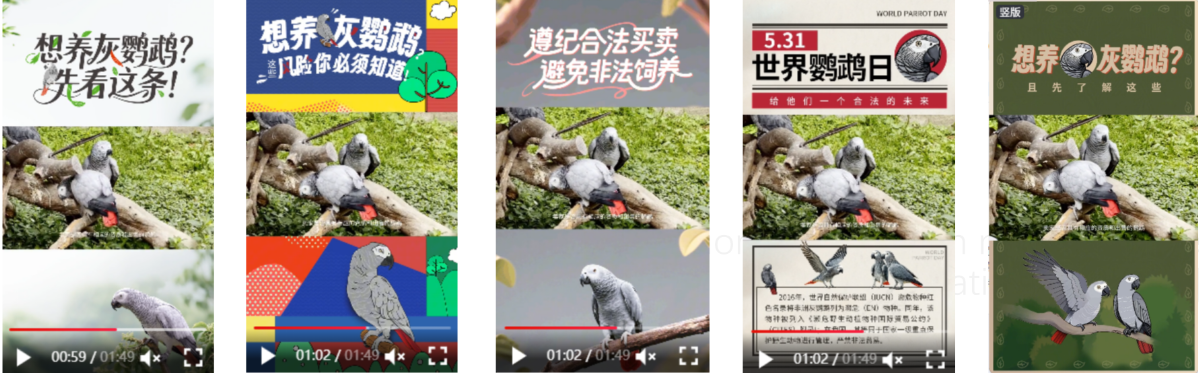
The campaign was delivered between May and December 2025, using consumer research and the CITES Demand Reduction Guidance to target the people most likely to be considering parrot ownership. On average, the campaign appeared around 13 times for each targeted user, helping reinforce the message before a buying decision was made.
The results suggest the message landed. A proportion of surveyed respondents who had initially considered buying parrots without legal documentation shifted towards not considering such purchases after seeing the campaign: 41% during the main delivery stage and 51% during the reinforcement stage.
Online monitoring also indicated fewer African grey parrots visible in online trade. During the intervention period, from May 2025 to February 2026, average online listings fell from a previous baseline of 61 per month to 16 per month — a promising decrease of ~74%.
This decline occurred alongside wider regulatory and enforcement action in China, including nationwide bird protection efforts. Physical market surveys across multiple cities also indicated fewer African grey parrots available.

“Addressing demand for illegally sourced wildlife requires a better understanding of how consumers make decisions. By applying this insight, we can design targeted interventions that reach specific audiences at scale and influence behaviour before a purchase is made. Our experience shows that clearer, accessible information can significantly support more informed choices,” said Ling Xu, Director of TRAFFIC’s China Office.
Around Lobéké National Park in southeast Cameroon, TRAFFIC’s community awareness work focused on source landscapes where wild parrots are at risk.
African grey parrots are listed as Endangered on the IUCN Red List and receive the highest level of protection under CITES Appendix I. In Cameroon, they’re also listed as a Class A protected species. Yet intelligence gathered through TRAFFIC’s work around Lobéké National Park suggests criminal activity is adapting to products that may be easier to conceal and harder to detect than live birds.
“What we are seeing is a deliberate move away from live birds towards wildlife products that are harder to detect, such as blood, skulls and feathers, but which originate from the same killing of a strictly protected species,” said Momballa Mbun Constant, Senior Research Officer, TRAFFIC Central Africa.
The warning emerged from the people living closest to the forest. From 17–27 March 2026, TRAFFIC visited six villages around Lobéké National Park — Ndongo, Mambélé, Koumela, Libongo, Lokomo and Mikel — using storytelling, presentations and group discussions to raise awareness of African grey parrots, their protected status, the risks they face, and the legal consequences of trafficking. Posters, flyers and stickers helped reinforce the message in visible community spaces, while daily radio broadcasts in French and local languages carried it beyond those attending in person.
In total, 505 people were reached directly, with overall reach estimated at more than 1,000 people. Seven community leaders from the six localities also signed commitments to help combat African grey parrot trafficking in their communities.

The activities also generated important community intelligence. Residents in five of the six villages reported that African grey parrot blood was being traded, raising concerns that traffickers may be shifting towards products that are easier to conceal and harder to detect than live birds.
While further research is needed to verify the information around trade in parrot blood and better understand the actors, routes and methods involved, the Conservator of Lobéké National Park also confirmed receiving similar information.
“The African grey parrot plays an essential role in forest regeneration and ecosystem balance in Lobéké. The evolution of trafficking methods demands stronger collaboration between conservation authorities, enforcement agencies and communities,” said Biloa Donatien Joseph Guy, Conservator of Lobéké National Park.
 The two pieces of work underline why tackling illegal wildlife trade requires action across the full value chain. Demand-reduction campaigns can reach consumers before illegal purchases are made. Community awareness can help people recognise protected species, understand the legal risks of trafficking, and share intelligence on emerging threats. Enforcement agencies can then use that information to stay alert to products that may otherwise be harder to detect.
For African grey parrots, this joined-up approach matters. Protecting the species means reducing demand for illegally sourced birds, identifying new trafficking methods as they emerge, and supporting the communities closest to the forests where these birds belong.
By listening to communities, reaching consumers before they buy, and alerting enforcement agencies, work like this can help keep more of these unique parrots in the wild.
Notes:
The work was carried out under the“Demand Reduction and Behaviour Change along China’s Parrot Supply Chains” Project, funded by the UK Government through the Illegal Wildlife Trade Challenge Fund.