Demand for frogs rising in West Africa
Cambridge, UK, 13 April 2010—The demand for frogs for human consumption is rising dramatically in parts of West Africa, according to a paper published in the latest issue of the TRAFFIC Bulletin. Dried or fried: amphibians in local and regional food market in West Africa describes the frog trade in Burkina Faso, Benin and Nigeria, based on interviews with local fishermen, collectors, market traders and others involved in the trade.
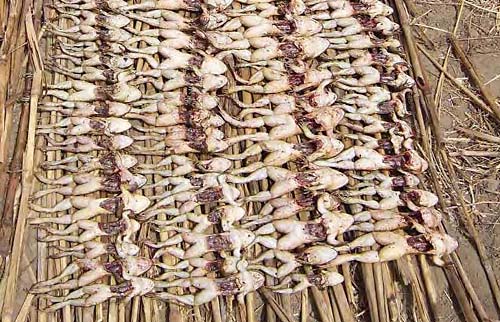
In Burkina Faso, almost all frogs collected were consumed locally, with the African Tiger Frog Hoplobatrachus occipitalis the most frequently eaten species. Frogs are usually sold to market traders who fry the specimens before sale. Villagers in the Ganzourgou region also eat toads, which are first skinned, beheaded, washed then dried to avoid the toxic skin secretions.
In Benin and Nigeria, frogs are transported to south-west of Nigeria for sale. Thirtyt-two traders between them handled around 2.7 million frogs per year, most originating from the northern savannah regions of Nigeria and from neighbouring Benin, Chad and Niger.
In Malanville, Benin, frogs are collected exclusively for the Nigerian market. There, many fishermen have recently switched to catching frogs, not because of higher profits, but because frogs can be sold in batches, providing a lump sum of income—around USD20 per sack. Increasing numbers of collectors from Nigeria are visiting the area to collect frogs. The authors accompanied a 30-strong team who between them caught around 450,000 (450 sackfuls) of frogs during a two-month stay in Malanville.
In Burkina Faso, frogs were often caught by hand or with nets, but in Benin, special frog traps are installed or torches are used to detect frogs at night from their eyeshine, before they are beaten on the head with a wooden stick.
There are indications the trade in frogs is unsustainable in some regions; in Burkina Faso, local people reported decreasing catches of frogs, although whether this is due to over-exploitation, habitat deterioration or other factors is unclear. There were similar reports from western Cameroon and eastern Nigeria, where even tadpoles are collected for food.
While frogs are clearly an important food source in the region, currently there are no regulations in any West African country governing the harvest.
Frogs are important in biological control too: in India, where the processing and export of frogs was banned because of a rise in agricultural pests and mosquito numbers, frog populations have largely recovered to former levels and the import of insecticides has dropped by 40%.
The authors suggest farming of large species, like the African Tiger Frog in West Africa should be investigated—to protect wild populations and provide a source of local income. However, they caution about the potential drawbacks, such as loss of income to villagers not involved in farming, land use and pollution from farms and the potential disease and health risks.
Dried or fried: amphibians in local and regional food market in West Africa by M. Mohneke, A.B. Onadeko, M. Hirschfeld and M.-O. Rödel, can be downloaded as part of the latest TRAFFIC Bulletin—the only peer-reviewed scientific journal dedicated to the wildlife trade. Other topics in the issue include an investigation into the wild meat trade in West Africa and the illicit ivory trade in Ethiopia. The Bulletin is also available, free-or-charge, by request.